
On November 28, 2012, the United Nations selected March 21 every year as International Day of Forests (IDF), the purpose of calling for nations to join hands in restoring their loss forests, raise awareness about the importance of forests, and offer solutions to protect and develop forests in a sustainable manner. In 2021, the IDF has the theme: “Forest restoration: a path to recovery and well-being”
Forests are home to about 80% of the world’s terrestrial biodiversity, with more than 60,000 species of trees[1]. Most importantly, forests play a role in absorbing CO2, returning oxygen to the world, as well as reducing the greenhouse effect due to CO2 accumulation which is a factor in global warming. About 1.6 billion people depend directly on forests for food, shelter, energy, medicine, and income. The world is losing 10 million hectares of forest each year – about the size of Iceland – which accounts for 12 to 20 percent of the global greenhouse gas emissions that contribute to climate change. Today, more than 1 million of the 8 million species of flora and fauna on the planet are in danger of extinction. Land degradation affects almost 2 billion hectares – an area larger than South America.
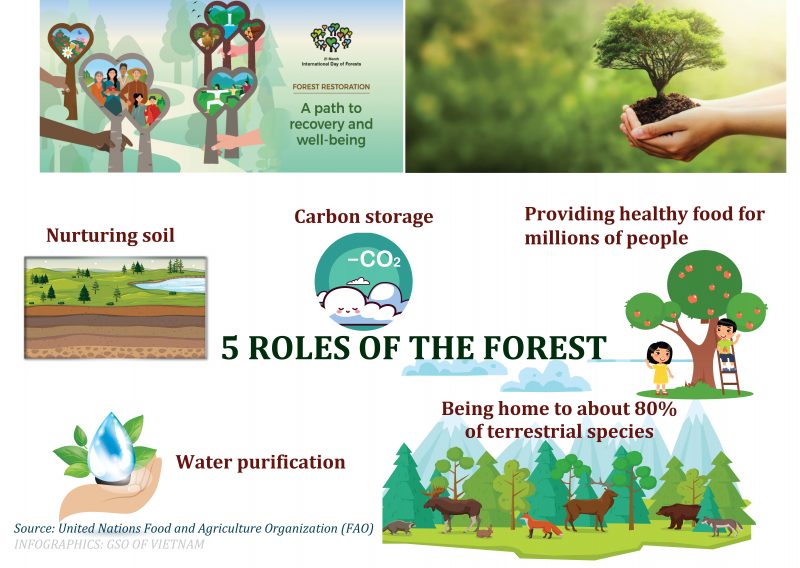
According to the United Nations Food and Agriculture Organization (FAO), forests have five important roles as nurturing soil, carbon storage, providing healthy food for millions of people, water purification, and being home to about 80% of terrestrial species. Sustainable forest management combining the proper use of forest resources is the best way to combat climate change and contribute to the prosperity and well-being of present and future generations.
For Vietnam, statistics in 2019 showed that forestry land was about 15 million hectares[2], accounting for 45.5% of the total area of the country, of which production forest was 7.5 million ha, protection forest was 5.2 million ha, the specialized forest was 2.2 million ha; the natural forest area was 1,0292.4 thousand hectares, the planted forest was 4316.8 thousand hectares. According to the Ministry of Agriculture and Rural Development, our country’s forest coverage rate in 2020 was estimated at 42% (the world average forest coverage rate: 31%). Although the rate of forest cover in our country has increased[3], the quality of natural forests was not high, protection forests have not fully utilized their functions, the ratio of trees/person is still low, the ratio of trees/person in big cities ranges from 2-3 m2/person, equal to 1/5 to 1/10 of the world (this rate in modern cities in the world popular from 20-25 m2/person).
Promoting the tree planting tradition initiated by Uncle Ho, the Prime Minister issued Decision No. 524 / QD-TTg approving the project “Planting a billion trees from 2021 to 2025” dated April 1st, 2021. According to the project, by the end of 2025, the whole country can plant 1 billion trees, of which 690 million trees are scattered in urban and rural areas; 310 million concentrated trees in protection forests, specialized forests, and planting new production forests to contribute protecting the ecological environment, improving the landscape and coping with climate change, developing socio-economic, improving the quality of people’s life and development, sustainable development of the country. It is estimated that in the first four months of 2021, the newly concentrated planted forest area nationwide reached 62 thousand hectares, an increase of 3.6% over the same period last year; the number of scattered planted trees reached 35 million, up 2.8%.
Sustainable forest restoration and management not only helps to handle climate change and biodiversity issues but also offers the potential to produce goods and services for sustainable development, boost economic activity, create jobs, and improve people’s lives. Generally, for the first four months of 2021, the exploited wood output reached 4,159.9 thousand m3, an increase of 4.9% over the same period last year; the export value of wood and wood products reached 4,988 million USD, up 50.5%; the export value of paper and paper products reached USD 486 million, up 5.3%.
Responding to this year’s IDF, on March 20, 2021, the Hanoi Wildlife Rescue Center received and released 92 individuals of 17 rare and precious wild animals in danger of extinction returned to the wildlife in Cuc Phuong National Park, Ninh Binh province[4]. It’s the first time that Cuc Phuong National Park has allowed visitors and people nearby together to release wild animals, and this is a case to raise the community’s awareness of conservation survival wild animals. Vietnam has also shown its determination in environmental protection and sustainable development in “Report on Intended Nationally Determined Contribution of Viet Nam” which updated latest and approved by the Prime Minister in July 2020. By 2030, total greenhouse gas (GHG) emissions will be reduced by 9% compared to the Business-as-Usual scenario (BAU), equivalent to 83.9 million tons of CO2; And if there is effective international cooperation, Vietnam could reduce by 27%, equivalent to 250.8 million tons of CO2.
In terms of land use, land-use change and forestry (LULUCF) are expected to contribute to the mitigation of GHG emissions from 9.3 to 21.2 million tons of CO2, through solutions: protection, conservation, and sustainable use of forests and forestland to increase carbon sequestration and forest certification; afforestation and forest development, with priority given to production forests, large timber forests and coastal forests; restoration of protective forests and special-use forests; zoning off for regeneration of natural forests, promoting forest regeneration and enrichment on lands planned for forestry; improving forest carbon stocks and quality; to develop agroforestry models to increase carbon stocks and conserve land.
The year 2021 marks the beginning of the United Nations’ Decade of Ecosystem Restoration, calling for action to prevent and reverse the degradation of forests and other ecosystems. Over the past years, people for the short-term economic interests have harmed the forest ecosystem, causing irreversible damage, or losses that will take many years to restore the original state. Now it is not too late for people to promptly repair and restore loss and damage to the forest. Keeping anything left of the forest is an urgent goal to protect our environment. Every year, various events are launched around the world and raise awareness about the importance of forests for the benefit of present and future generations. On International Day of Forests, let us sow the seeds of a sustainable future by committing to restoring and conserving our forests for the benefit of people and the planet./.
[1] Source: https://www.un.org/en/observances/forests-and-trees-day
[2] Statistical Yearbook 2019, General Statistics Office
[3] The forest coverage rate for the years 2010-2020 as follows: 39.5%; 39.7%; 40.7%; 41%; 40.4%; 40.8; 41.2%; 41.5%; 41.7%; 41.9%; 42%.
[4] Source: http://cucphuongtourism.com.vn/index.php/vi/tin-tc/385-bn-mun-tn-thy-tai-th-ng-vt-hoang-da-v-rng .html