
INTERNATIONAL AND NATIONAL ECONOMIC CONTEXT
I. ECONOMIC GROWTH
In the nine months of 2026, the global economy continued to face pervasive uncertainties driven by rapid and highly unpredictable developments. Prolonged armed conflicts in Russia-Ukraine, and the Middle East, compounded by intensifying strategic competition and protectionism, alongside major economies shifting their trade and monetary policies, severely disrupted supply chains, energy markets, raw material prices, freight costs, and international trade. Concurrently, global inflation resurged while public debt expanded further. Extreme weather events and natural disasters exacerbated by climate change intensified globally, causing severe casualties and property damage. Energy security, food security, and cybersecurity remained critical challenges. Conversely, a strong wave of investment in artificial intelligence (AI) infrastructure and semiconductor technology provided impetus for global economic growth.
Against this backdrop, international organizations made varying adjustments to their 2026 global economic growth forecasts. The Organization for Economic Cooperation and Development (OECD)[1] and the United Nations (UN)[2] revised their global growth forecasts upwards by 0.1 percentage points, though both figures remained significantly below 2025 growth rates. Specifically, the OECD pegged 2026 global economic growth at 2.9% (0.5 percentage points lower than in 2025), while the UN projected it at 2.6% (down 0.3 percentage points). In opposition, the International Monetary Fund (IMF)[3], downgraded its 2026 global growth forecast by 0.1 percentage points to 3.0%, the highest estimate among these international organizations, but still marked a 0.5 percentage points deceleration from the 2025 performance.
For the Southeast Asia[4], while growth projections for individual economies varied across organizations, a strong consensus remained that Viet Nam would lead the region in growth performance. Accordingly, Viet Nam’s growth in 2026 was projected at 7.5%-8.2%[5], substantially outpacing regional peers, namely Indonesia (5.0%-5.2%), Malaysia (4.7%-4.9%), the Philippines (3.3%-4.1%), Singapore (4.8%-5.0%), and Thailand (1.9%-2.4%).
Domestically, the Government and the Prime Minister decisively directed ministries, agencies, and localities to focus on implementing a comprehensive suite of solutions aimed at driving economic growth, targeting double-digit growth in 2026. The completion and operationalization of the two-tiered local government model have contributed to expanding development space, strengthening regional linkages, and creating conditions to improve the effectiveness and efficiency of state management; while simultaneously promoting decentralization, delegation of power, administrative procedure reform, and the effective mobilization and utilization of resources for development. Consequently, despite external volatility, socio-economic performance in the third quarter and the first nine months of 2026 sustained strong upward trajectories across most macroeconomic sectors. Specifically:
1. Gross Domestic Product (GDP, GRDP)
Gross Domestic Product (GDP) in the third quarter of 2026 (Q3 2026) was estimated to expand by 9.95% year-on-year (YoY), outpacing the 8.15% and the 8.81%[6] growth rates recorded in the first and second quarters. By economic sector, the agriculture, forestry, and fishing grew by 4.21%, contributing 5.14% to the economy’s total value-added growth; the industry and construction surged by 12.50%, contributing 51.57%; and the services increased by 9.54%, contributing 43.29%.
In terms of the expenditure approach to GDP in Q3 2026, final consumption expenditure increased by 8.96% YoY; gross capital formation rose by 21.39%; exports of goods and services surged by 23.27%, while imports of goods and services grew by 28.75%.
GDP for the nine months of 2026 was estimated to increase by 9.01% year-on-year. Of which, the agriculture, forestry, and fishing sector grew by 4.02%, contributing 5.35% to the economy’s total value-added growth; the industry and construction sector advanced by 11.21%, contributing 49.62%; and the services sector rose by 8.69%, contributing 45.03%.
In the agriculture, forestry, and fishing sector, rice, fruit, livestock, and aquaculture output expanded steadily, satisfying both domestic and export demands. The sector’s value-added in the nine months of 2026 grew by 4.02% year-on-year. Specifically, the agriculture advanced by 3.72%, contributing 3.60% to the economy’s total value-added growth; the forestry rose by 3.99%, contributing 0.25%; and the fishing surged by 4.99%, contributing 1.50%.
Within the industry and construction sector, the industry maintained robust growth, driven by expanding structural capacity, the commissioning of several large-scale projects, the recovery in export orders, and accelerated public investment, which collectively generated a ripple effect across production and construction activities. The sector’s value-added in the nine months of 2026 increased by 11.02 % year-on-year, contributing 41.39% to the economy’s total value-added growth. Of which, the manufacturing remained the primary growth driver with a growth rate of 11.36%, contributing 33.85%; while the construction surged by 12.22%, contributing 8.23%.
In the services sector, trade, transportation, tourism, and consumer services maintained positive momentum, while robust domestic demand for goods, services, and travel made a substantial contribution to overall economic growth. The sector’s value-added in the nine months of 2026 expanded by 8.69% year-on-year. Several sub-sectors posted strong growth and high contributions to the economy’s total value-added growth included: Transportation and storage (+11.03% YoY, contributing 7.21%); wholesale and retail trade (+9.85% YoY, contributing 11.99%); finance, banking, and insurance activities (+9.45% YoY, contributing 5.27%); and accommodation and food service activities (+8.83% YoY, contributing 2.69%).
Regarding the economic structure, in the nine months of 2026, the agriculture, forestry, and fishing sector accounted for 10.65%; the industry and construction sector for 38.35%; the services sector for 42.97%; and the taxes less subsidies on products for 8.03% (The corresponding structure for the same period in 2025 was 11.33%; 37.47%; 43.05%; and 8.15%).
In terms of the expenditure approach to GDP for the nine months of 2026, final consumption expenditure expanded by 8.51 % year-on-year; gross capital formation rose by 17.88%; exports of goods and services grew by 21.29%; and imports of goods and services increased by 27.19%.
Regarding Gross Regional Domestic Product (GRDP) for the nine months of 2026, out of 34 localities, 12 achieved double-digit GRDP growth rates. Quang Ninh led national rankings with a GRDP growth rate of 12.54%, followed by Ha Tinh (12.36%), Hai Phong (12.08%), Bac Ninh (11.81%), and Ninh Binh (11.31%). Conversely, several localities recorded lower GRDP growth, including Son La (5.59%), Vinh Long (7.32%), Ca Mau (7.37%), and Dong Thap (7.44%), due to contractions in local electricity generation and a high concentration of primary agriculture in their economic structures. Overall, robust growth was concentrated in localities with strong industrial foundations and large-scale manufacturing. This momentum was further bolstered by vigorous investment, expanding exports, and a thriving service sector, providing a vital thrust to national economic growth.
2. Agricultural, forestry, and fishing production yielded positive results in the third quarter and in the nine months of 2026. Rice yield and production both witnessed an upward trend, meeting the demands of domestic consumption and exports, while fruit production saw significant year-on-year growth. Pig and poultry farming continued to expand, resulting in increased live-weight production. Wood production due to sustained demand for processing and exports, and aquaculture maintained its growth momentum thanks to the increased application of high-tech solutions.
a) Agriculture
Localities nationwide cultivated 1,861.6 thousand hectares, a year-on-year decrease of 36.8 thousand hectares[7]. Specifically, Northern localities accounted for 158.8 thousand hectares (-14.0 thousand hectares), while Southern localities accounted for 1,702.8 thousand hectares (-22.8 thousand hectares, the Mekong River Delta contributed 1,219.0 thousand hectares (- 20.1 thousand hectares). The national average yield of the summer-autumn rice was estimated at 58.9 quintals/ha (+1.5 quintals/ha), production was estimated at nearly 11.0 million tones, a year-on-year expansion of 71.2 thousand tones
As of September 20th, 2026, localities nationwide sown 1,337.1 thousand hectares of winter rice, a year-on-year[8] decrease of 45.0 thousand hectares, of which the North reached 944.6 thousand hectares (-33.9 thousand hectares), and the South reached 392.5 thousand hectares (-11.1 thousand hectares).
As of September 20th, 2026, localities nationwide sown 474.1 thousand hectares of autumn-winter rice, a year-on-year decrease of 130.7 thousand hectares.
At the same time, the cultivated area for maize was estimated at 803.5 thousand hectares (equal to 99.6% YoY); sweet potatoes reached 68.4 thousand hectares (98.4% YoY); soybeans accounted for 23.7 thousand hectares (100.4% YoY); peanuts stood at 132.7 thousand hectares (97.6% YoY); various vegetables reached 907.7 thousand hectares (100.2% YoY); and different types of beans were estimated at 93.5 thousand hectares (96.5% YoY.
Generally, in the nine months of 2026, the production of some primary industrial crops was as follows: coconuts reached nearly 2.1 million tones, (+6.6% YoY); tea buds reached 990.1 thousand tones (+5.1% YoY); cashews reached 323.9 thousand tones (+ 4.8% YoY); black pepper reached 273.4 thousand tones (+4.8% YoY); and rubber reached 955.1 thousand tones, (+3.9%). Production of some primary fruits were as follows: durians at 1.3 million tones (+13.8% YoY); jackfruit at 1.0 million tones (+8.7% YoY); mangoes at 1.0 million tones (+ 4.7% YoY); and bananas at 2.3 million tones, (+ 4.0% YoY).
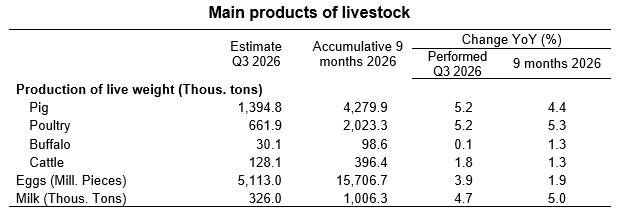
Cattle and buffalo farming continued a downward trend due to shrinking grazing areas and low economic returns. Pig farming experienced mix of favorable conditions and challenges; while rising live weight price[9] encouraging farmer to maintain operations and repopulation, the cost of animal feed rose over the past nine months, driving up input costs and squeezing profitability. Poultry farming showed an upward trend, supported by the sector’s adaptability to market fluctuations, short production cycles, rapid capital turnover, and stable consumer demand for meat and eggs. Integrated farm models and business partnerships helped to improve disease control capabilities.
b) Forestry
The damaged forest area during nine months of 2026 was estimated at 1,146.9 hectares, a year-on-year increase of 14.9%, of which 733.0 hectares of forest fires (+132.9%), while 413.9 hectares of illegal logging, deforestation, and encroachment (- 39.5%).
In the nine months of 2026, the area of newly planted concentrated forests was estimated at 215.8 thousand hectares, a year-on-year decrease of 3.0%, with the third quarter of 2026 alone accounting for 70.6 thousand hectares (-1.2% YoY). Meanwhile, reached 71.3 million (+1.6% YoY), of which the number of scattered forestry trees planted in the Q3 2026 was estimated at 19.9 million trees, equal to the same period in 2025. Wood production reached 18.9 million cubic meters (+5.3% YoY), with the production in the Q3 2026 contributing 7.1 million cubic meters (+6.0% YoY).
The damaged forest area[10] during nine months of 2026 was estimated at 1,146.9 hectares, a year-on-year increase of 14.9%, of which 733.0 hectares of forest fires (+132.9%), while 413.9 hectares of illegal logging, deforestation, and encroachment (-39.5%).
c) Fishing
Generally, capture fisheries and aquaculture production in the nine months of 2026 was estimated at 7,890.9 thousand tones, (+3.9% YoY). (the production in the Q3 in 2026 reached 2,851.8 thousand tones, (+4.3%), of which fish reached 5,410.9 thousand tones (+ 2.8%), shrimp reached 1,376.4 thousand tones (+7.1%), and other aquatic products reached 1,103.6 thousand tones (+ 5.8%).
Aquaculture production in the nine months of 2026 was estimated at 4,860.6 thousand tones, a year-on-year increase of 5.9% (production in the Q3 in 2026 reached 1,822.9 thousand tones, (+ 6.1%), including fish 3,053.7 thousand tones (+4.5%), shrimp 1,279.4 thousand tones (+7.6%), and other aquatic products at 527.5 thousand tones (+10.4%).
Capture fisheries production in the nine months of 2026 was estimated at 3,030.3 thousand tones, a year-on-year increase of 0.9% (the production in the Q3 2026 was estimated at 1,028.9 thousand tones, (+1.4%), including fish 2,357.2 thousand tones (+ 0.6%), shrimp 97.0 thousand tones (+ 1.7%), and other aquatic products 576.1 thousand tones (+ 1.9%).
3. Industrial production in Q3 2026 continued to maintain double-digit growth, with the Index of Industrial Production (IIP) estimated to increase by 14.8% year-on-year [11]. In the first nine months of 2026, the IIP was estimated to rise by 12.3% compared with the same period last year, marking the highest nine-month growth rate recorded since 2019, of which manufacturing expanded by 12.9%[12] .
Generally, in the first nine months of 2026, the IIP was estimated to grow by 12.3% over the same period last year (the corresponding figure in 2025 was 9.0%). Specifically, the manufacturing grew by 12.9% (the corresponding figure in 2025 was 10.3%), contributing 10.0 percentage points to the overall growth; the electricity supply rose by 10.6% (versus 6.3% in 2025), contributing 0.9 percentage points; the water supply, sewerage, waste management and remediation activities increased by 9.3% (versus 8.6% in 2025), contributing 0.1 percentage points; and the mining and quarrying grew by 8.0% (a decline of 0.4% in the same period of 2025), contributing 1.3 percentage points.
Generally, in the first nine months of 2026, Index of Industrial Shipment (IIS) of the manufacturing recorded a year-on-year increase of 12.8%.
Index of Industrial Inventory of the manufacturing as of September 30th, 2026 was estimated to increase by 4.3% compared with the previous month and by 11.9% compared with the same period last year.
Number of employees in industrial enterprises as of September 1st, 2026 increased by 1.0% compared with the previous month and by 3.4% compared with the same period last year.
4. The number of registered enterprises in the first half of 2026 increased by 3.2% YoY. The number of enterprises entering the market was higher than the number of enterprises withdrew from the market.
a) Enterprise registration
In September, the country had over 11.6 thousand newly established enterprises with a registered capital of nearly 175.8 trillion VND and registered employees of nearly 75.5 thousand employees, a month-on-month decrease of 4.9% and 7.2% in the number of enterprises and in the registered capital, respectively and increase of 25% in the number of employees. In comparison with the same period last year, in the number of enterprises, the registered capital and the number of employees showed a decrease of 31.1%, an increase of 6.0%, and a decrease of 22.2%, respectively.
Overall, in the first nine months of 2026, the whole country had nearly 149.7 thousand newly registered enterprises with a total registered capital of 1,884.0 trillion VND and total registered employees of over 733.1 thousand employees, a year-on-year increase of 3.2%, 32.7% and a decrease of 16.1% in the number of enterprises, in registered capital and in the number of employees, respectively. The average registered capital of a newly established enterprise in the first nine months of 2026 reached 12.6 billion VND (+28.5% YoY). The total registered capital added to the economy in the first nine months of 2026 reached over 5.0 quadrillion VND (+6.1% YoY). In addition, the country had nearly 74.3 thousand resumed operation enterprises (a year-on-year decrease of 14.0%). Overall, the number of newly established and resumed operation enterprises in the first nine months of 2026 reached over 223.9 thousand enterprises (-3.2% YoY); on average, there were 24.9 thousand enterprises entered the market each month.
In the first nine months of 2026, the number of enterprises temporarily suspending for a definite time was nearly 89.8 thousand enterprises (-9.7% YoY); 33.5 thousand enterprises suspended operation waiting for dissolution procedures (-37% YoY); and over 48.7 thousand enterprises completed procedures for dissolution, (+118.8% YoY). On average, 19.1 thousand enterprises withdrew from the market each month.
b) Business tendency of the enterprise
The results of the business tendency survey of enterprises in the manufacturing in Q3 2026 showed that: 34.2% of enterprises assessed that their business performance was better than in Q2 2026; 45.7% of enterprises said that the business performance was stable, and 20.1% of enterprises faced difficulties[13]. It is expected that in Q4 2026, 39.2% of enterprises presented that the tendency would get better than that in Q3 2026; 44.7% of enterprises believed the business performance would be stable, and 16.1% of enterprises predicted that it would be more difficult.
5. Commercial and service activities maintained a relatively high growth rate thanks to improved domestic purchasing power; transport meeting the freight and travel demands of residents; intensified tourism promotion programs, events, and festivals, contributing to consumption stimulation and tourist attraction.
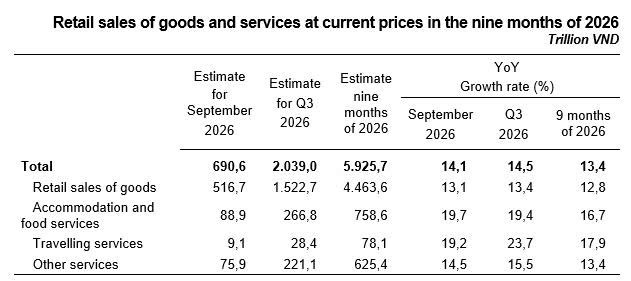
In Q3 2026, total retail sales of goods and services at current prices was estimated at 2,039.0 trillion VND, a year-on-year surge of 14.5%; passengers carried and passenger carried (passenger-kilometers) witnessed a year-on-year surge of 15.9% and 11.5%, respectively; ; freight transported and freight transported (ton-kilometers) shot up 18.1% and 15.1%, respectively; telecommunications turnover increased by 8.0%; international visitors to Viet Nam expanded by 13.8%.
In general, for the nine months of 2026, total retail sales of goods and services at current prices reached an estimated 5,925.7 trillion VND, a year-on-year growth of 13.4%, or climbed up 7.8% in real terms after excluding price factors (compared to 7.2% in 2025).
Passenger carried in the nine months of 2026 was estimated at 5,300.8 million passengers carried, a year-on-year increase of 17.4%, and passenger carried (passenger-kilometers) attained 262.0 billion passenger-kilometer, a increase of 11.9%. Of which, in Q3 2026, passengers carried was estimated at 1,914.4 million turns, a year-on-year soar of 15.9%, and passenger-kilometers reached 91.3 billion passenger-kilometers, an upturn of 11.5%.
Freight transport in the nine months of 2026 was estimated at 2,580.2 million tons, a year-on-year expansion of 15.8%, and freight transported (ton-kilometers) retained 510.1 billion ton-kilometer, a year-on-year soar of 12.8%. Of which, in the Q3 2026 freight transported was estimated at 941.3 million tons, a year-on-year surge of 18.1%, and freight transported (ton-kilometers) gained 184.3 billion ton-kilometer, a climb of 15.1%.
Telecommunications revenue in the nine months of 2026 was estimated at 380.3 trillion VND, a year-on-year increase of 6.86% (or a rise of 6.94% in real terms after excluding price factors). The total number of telephone subscribers as of the end of September was estimated at 114.1 million, a year-on-year decrease of 7.9% (the number of mobile subscribers was 111.1 million, a decline of 8.6%). The number of DSL internet subscribers as of the end of September was estimated at 25.0 million, a year-on-year downturn of 0.04%.
International visitors to Viet Nam[14] in the nine months of 2026 reached 17.7 million arrivals, a year-on-year surge of 14.5%. Of which, arrivals by airway reached 14.7 million arrivals, accounting for 83.2% of total international visitors and a year-on-year rise of 11.9%; arrivals by road obtained 2.7 million arrivals, accounting for 15.4% and a spike of 29.9%; arrivals by seaway achieved 243.4 thousand arrivals, accounting for 1.4% and a shoot of 27.7%.
The number of outbound[15] Vietnamese citizens in the nine months of 2026 reached 4.3 million, a year-on-year plunge of 21.2%.
6. Deposit and lending interest rates remained generally stable, supported by a monetary policy executed in a proactive, flexible, and timely manner. This monetary stance was seamlessly coordinated with fiscal policies and other macroeconomic measures. The insurance market maintained stable operations, while the securities market achieved a major milestone following its official reclassification to a Secondary Emerging Market by global index provider FTSE Russell, a pivotal upgrade expected to significantly expand access to investment capital.
As of September 28th, 2026, the capital mobilization by credit institutions witnessed a year-on-year increase of 9.78% (the corresponding figure in 2025 was 9.99%). Meanwhile, credit growth of the economy reached 10.89% (the corresponding figure in 2025 was 13.37%).
Cumulatively for the nine months of 2026, total premium revenue was estimated to reach 175.8 trillion VND, a rise of 2.4%. Specifically: Life insurance premium revenue was estimated at 101.7 trillion VND, down 5.2%, while the non-life insurance premium revenue was estimated to reach 74.1 trillion VND, up 15.1%.
In the stock market, as of September 30th, 2026, the VN-Index reached 1,768.62 points, representing a 0.9% decrease compared to the end of 2025. Market capitalization of listed stocks reached 10,306.94 trillion VND, marking a 3.3% increase.
7. Total disbursed investment of the economy in the first nine months of 2026 at current prices, was estimated at 3,109.6 trillion VND, a year-on-year increase of 15.1% higher than the growth of 11.6% recorded during the same period in 2025. This growth reflected the effectiveness of macroeconomic management polices, the determined acceleration of public investment projects, and the solid confidence of the private sector and foreign investors, all serving as key divers for economic growth in 2026. The disbursed foreign direct investment (FDI) in Viet Nam during this nine-month period was estimated at 21.07 billion USD, a year-on-year increase of 12.1%, making the highest nine-month level record since 2022.
In the first nine months of 2026, the total disbursed investment capital at current prices was estimated to reach 3,109.6 trillion VND, a year-on-year increase of 15.1% (Q3 2026 was estimated at 1,291.2 trillion VND, a year-on-year increase of 16.7%), including: the state sector’s investment was at 931.0 trillion VND, accounting for 30.0% of the total investment and rising by 17.3%; the non-State sector’s investment reached 1,649.2 trillion VND, accounting for 53.0% and rising by 14.0%; and the FDI sector’s investment achieved 529.4 trillion VND, accounting for 17.0% and rising by 14.5%.
Total inward foreign direct investment in Viet Nam[16] as of September 30th, 2026, including: Newly registered capital, adjusted registered capital, and capital contributions and purchasing shares by foreign investors reached 50.36 billion USD, a year-on-year increase of 76.4%. Of which: 3,108 projects were newly licensed with a total registered capital of 29.24 billion USD, representing a year-on-year increase of 6.2% in the number of projects and an upturn of 2.4 times in terms of registered capital. Regarding adjusted registered capital, 948 projects that were licensed in previous years registered to adjust their investment to increase of 14.15 billion USD, a year-on-year upturn of 25.1%; There were 2,335 turns of registered of capital contributions and purchasing shares by foreign investors with a total capital contribution value of 6.97 billion USD, a year-on-year increase of 44.0%.
Disbursed FDI in Viet Nam in the first nine months of 2026 was estimated at 21.07 billion USD, a year-on-year increase of 12.1%.
8. State budget revenue [17] in the nine months of 2026 recorded a year-on-year increase of 12.1%. State budget expenditure increased by 14.5%, effectively meeting the needs for socio-economic development, national defense, security, state management, payment of due debts, and timely payment to beneficiaries according to regulations.
Total state budget revenue in September 2026 was estimated at 162.7 trillion VND. The total state budget revenue accrued in the 9 months of 2026 was estimated at 2,187.3 trillion VND, reaching 86.5% of the annual estimate and going up by 12.1% over the same period last year. Specifically: The accrued revenue in the 9 months of 2026 was estimated at 1,880.3 trillion VND, reaching 85.5% of the annual estimate. This figure accounted for 86.0% of total state budget revenue, representing a 12.2% increase YoY.
Total state budget expenditure in September 2026 was estimated at 256.8 trillion VND. In the 9 months of 2026, total state budget expenditure reached an estimated 1,873.7 trillion VND, reaching 59.3% of the annual estimate and marking a 14.5% increase YoY.
9. Export and import of goods and services[18] nine months 2026 hit a record YoY, many key export items saw a significant growth.
a) Export and import of goods[19]
In September 2026, the total export and import turnover of goods 117.69 billion USD, a month-on-month increase of 7.3% and a year-on-year increase of 42.2%. Specifically, the trade balance sheet returned to a surplus amounting to 1.27 USD billion after nine consecutive months of deficits. Generally, in nine months of 2026, export turnover of goods reached 888.02 billion USD, a year-on-year increase of 30.4%. Of which export turnover rose by 24.5% and imports by 36.7%[20]. The trade balance sheet in goods in nine months showed a deficit of 19.42 billion USD.
The export turnover of goods in September reached 59.48 billion USD, a year-on-year increase of 8.5%. In the Q3 2026, total export turnover reached 167.85 USD billion, (+30.4% YoY and +17.0% QoQ). Generally in nine months of 2026, the export turnover of goods reached 434.30 billion USD, a year-on-year rise of 24.5%.
Import turnover of goods in September 2026 reached 58.21billion USD, a rise of 6% MoM. In Q3 of 2026, import turnover reached 170.33 billion USD, a year-on-year increase of 42.2% and 8.8% QoQ. Generally, in nine months of 2026, the import turnover of goods reached 453.72 billion USD, a year-on-year surge of 36.7%.
According to preliminary data, the trade balance recorded a surplus of 1.27 USD billion in September. Generally in nine months of 2026, the trade balance showed a deficit of 19.42 billion USD[21], comparing to a surplus of 16.87 billion USD, YoY. Specifically, the domestic economic sector recorded a deficit of 34.28 billion USD, while the FDI sector (including crude oil) posted a surplus of 14.86 billion USD.
b) Export and import of services
In Q3 2026, the export turnover of services was estimated at 8.71 billion USD, a year-on-year increased of 15.1% and rose by 6.0% compared to the previous quarter; import turnover of services was estimated at 11.82 billion USD, up 11.4% YoY and up 4.3% QoQ.
Generally, in nine months of 2026 cumulatively, export turnover of services was estimated at 26.10 billion USD, rising by 18.5% YoY, of which tourism services reached 13.06 billion USD (accounting for 50.7% of total turnover), growing by 17.4%; transport services reached 7.81 billion USD (accounting for 29.9%), surging by 29.5%.
Import turnover of services in nine months of 2026 was estimated at 34.31 billion USD (including transportation and insurance service fees for imported goods amounted to 14.39 billion USD), rising by 15.0% YoY, of which transport services reached 16.40 billion USD (accounting for 47.8% of total turnover), growing by 35.1%; tourism services reached 10.85 billion USD (accounting for 31.6%), declined by 2.2%.
The trade deficit of services in nine months of 2026 was 8.21 billion USD.
10. Consumer Price Index (CPI) in September witnessed a month-on-month increase of 0.62%, mainly due to upward adjustments to domestic petrol and oil prices in line with the prices of world fuel. The CPI in September saw a rise of 4.20% compared with that in December 2025 and recorded a year-on-year surge of 5.08%.
The average CPI in Q3 2026 expanded by 4.80% compared with Q3 2025. On average for the nine months of 2026. The average CPI in the nine months of 2026 experienced a year-on-year jump of 4.52%; core inflation witnessed an increase of 4.26%.
a) Consumer price index
Nine out of 11 major groups of consumer goods and services recorded an increase[22] in the price index in a month-on-month upturn of 0.62% and 02 groups experienced a decline[23].
The average CPI in Q3 2026 expanded by 4.80% compared to that in Q3 2025.
The average CPI in the nine months of 2026 possessed a year-on-year upturn of 4.52%.
Core inflation[24] in September experienced a month-on-month increase of 0.11% and a year-on-year rise of 4.45%. On average, the core inflation in the nine months of 2026 witnessed a year-on-year upturn of 4.26%, lower than an expansion of 4.52% in the overall CPI[25].
b) Gold and US dollar price index
The gold price index in September witnessed a month-on-month rise of 2.38%; a year-on-year shoot of 12.42%; and a decline of 4.04% compared to that in December 2025. The average gold price index in the nine months of 2026 possessed a year-on-year spike of 42.67%.
The domestic US dollar price index in September experienced a month-on-month shrink of 0.69%; a year-on-year decrease of 1.34%; and a drop of 1.07% compared to that in December 2025. The average US dollar price index in the nine months of 2026 saw a year-on-year soar of 1.01%.
c) Producer price index
In the nine months of 2026, the global commodity market continued to evolve in a complex manner due to geopolitical tensions, particularly in the Middle East, increasing risks to energy supply and international transport. Domestically, the Government implemented nationwide a synchronous set of solutions to maintain macroeconomic stability, control inflation, and support production and business activities. Under these circumstances, the producer price index; input producer price index; and merchandise export and import price index in the nine months of 2026 all witnessed a year-on-year expansion, reflecting the impact of price fluctuations on the international market and the recovery of domestic production and consumption.
In Q3 2026, the producer price index for agriculture, forestry and fishing was estimated to shrink by 1.16% QoQ but expanded by 4.20% YoY; the producer price index for industrial products experienced a quarter-on-quarter increase of 0.47% and a year-on-year jump of 4.75%; the producer price index for services saw a quarter-on-quarter reduction of 0.13% but a year-on-year upturn of 4.14%; the input producer price index possessed a quarter-on-quarter contraction of 0.13% but a year-on-year upturn of 4.57%.
In general, the producer price index for agriculture, forestry and fishing in the nine months of 2026 witnessed a year-on-year soar of 4.11%; the producer price index for industry possessed a year-on-year climb of 4.37%; the producer price index for services saw a year-on-year expansion of 4.02%; and the input producer price index recorded a year-on-year surge of 5.12%.
II. SOCIAL SITUATION
1. The labour market in the nine months of 2026 demonstrated positive trends. The size of the labour force, the number of employed persons, and monthly average income per employee all increased compared to the previous quarter and the same period last year. The unemployment rate remained at 2.22%; the underemployment rate at working age was 1.53%, lower than that in the same period last year. These results reflected continued improvements in labour demand as well as production and business activities.
In Q3 2026, the labour force aged 15 and over in the country was estimated at 54.1 million persons, a quarter-on-quarter growth of 278.4 thousand persons and a year-on-year increase of 709.7 thousand persons; the proportion of trained employees with diplomas/certificates was 30.4%, 0.6 percentage points higher than the previous quarter and 1.1 percentage points higher than the same period last year. Generally, in the nine months of 2026, the labour force aged 15 and over reached 53.8 million persons, a year-on-year increase of 697.0 thousand persons; the proportion of trained employees with diplomas/certificates was 29.9%, a growth of 0.8 percentage points.
The number of employed persons in Q3 2026 was 53.0 million persons, a quarter-on-quarter increase of 292.3 thousand persons and a year-on-year growth of 706.4 thousand persons. Generally, in the nine months of 2026, the number of employed persons reached 52.7 million persons, an increase of 683.8 thousand persons YoY.
The underemployment rate at working age[26] in Q3 2026 was 1.31%, going down 0.31 percentage points QoQ and falling by 0.19 percentage points YoY. Generally, in the nine months of 2026, the underemployment rate at working age was 1.53%, decreasing by 0.12 percentage points YoY.
The monthly average income per employee in Q3 2026 was 9.2 million VND per month, going up 215.5 thousand VND QoQ and growing by 823.8 thousand VND YoY. Generally, in the nine months of 2026, the monthly average income per employee reached 9.1 million VND per month, rising by 752.8 thousand VND (or +9.1%) YoY.
The unemployment rate at working age[27] in Q3 2026 was 2.22%. Generally, in the nine months of 2026, the unemployment rate at working age was 2.22%, equivalent to that in the same period last year, of which the rate in urban areas was 2.55%; rural areas was 1.99%.
In Q3 2026, the labour underutilisation rate[28] was 3.63% (equivalent to about 1.9 million persons). Generally, in the nine months of 2026, the labour underutilisation rate stood at 3.92%[29].
The number of own-account workers in Q3 2026 was 4.2 million persons, a year-on-year rise of over 400 thousand persons. Generally, in the nine months of 2026, own-account workers reached 4.1 million persons, rising by 272.1 thousand persons YoY.
2. In the nine months of 2026, people’s living conditions remained stable, and social security was improved. The Government and local authorities implemented synchronously, promptly, and effectively support policies for national devotees, poor and near-poor households, social protection beneficiaries, and population groups facing difficulties.
According to the results of the Labour Force Survey in Q3 2026, the proportion of households reporting that their income in the month remained unchanged or increased compared to the same period in 2025 was 96.8% (going up 0.3 percentage points QoQ and rising by 0.5 percentage points YoY).
As of September 25th, 2026[30], in the nine months of this year, total social security support funds disbursed for various target groups reached nearly 69.3 trillion VND. Of which: visits, encouragement, and gifts to social protection beneficiaries under Decree No. 20/2021/ND-CP dated March 15th, 2021 reached nearly 32.4 trillion VND; support for poor, near-poor, disadvantaged, and social policy households was over 3.2 trillion VND; national devotees and their relatives received over 33.3 trillion VND; and other sudden and unusual support in localities reached over 246.6 billion VND. In addition, social insurance agencies issued nearly 35.1 million health insurance cards, free medical examination and treatment cards or books to beneficiaries.
Also in the nine months of this year, the Government provided nearly 18.1 thousand tons of rice to the people. Of which: nearly 9.1 thousand tons for hunger relief during the Binh Ngo Lunar New Year for 604.6 thousand persons; more than 8.2 thousand tons for pre-harvest hunger relief for 547.2 thousand persons; and 887.4 tons for natural disaster and flood relief for about 59.1 thousand persons.
Regarding gratitude to national devotees: The “500-day-and-night campaign to accelerate the search, collection, and identification of martyrs’ remains” towards the 80th anniversary of Invalids and Martyrs Day (July 27th, 1947 – July 27th, 2027) is being drastically deployed by authorities at all levels, sectors, units, and localities.
According to data from the 500-day-and-night campaign[31] as of September 23rd, 2026, the search and collection of martyrs’ remains continued to achieve significant results: 2,803 martyrs’ remains were found and collected, including 1,773 remains found domestically, 174 remains in Lao PDR, and 856 remains in Cambodia; sampling was conducted for 199,908 martyrs’ graves serving forensic identification (reaching 94.78% of progress), of which 139,016 graves were eligible for sampling (reaching 69.35%), and 60,892 graves were not eligible for sampling; 99,443 martyrs’ remains samples from localities were received, stored, and preserved. Along with searching and collecting, localities and functional forces organized 18 memorial and burial ceremonies for martyrs’ remains, receiving 893 martyrs’ remains for burial according to regulations.
3. Education and training
Regarding the Upper Secondary School Graduation Examination: A total of 1,223,776 candidates registered for the examination nationwide, up by 61,642 candidates year on year (of these, 1,213,695 candidates sat the examination, representing 99.18% of registered candidates). The examination was held at 2,478 examination sites, with 54,409 examination rooms. A total of 74 candidates were suspended from the examination, including 69 cases involving mobile phones being brought into the examination room and 5 cases involving the use of unauthorised materials during the examination[32].
Regarding the opening of the 2026-2027 school year, on the morning of September 5th, 2026, educational institutions nationwide held opening ceremonies simultaneously in a hybrid format, combining in-person and online participation. The ceremony was connected from the central venue at Muong Khuong Primary and Lower Secondary Boarding School in Lao Cai to provinces and centrally governed cities across the country. In the 2026-2027 school year, nearly 27 million pupils and students nationwide began the new academic year[33]. The theme for the 2026-2027 school year is “Renewing mindsets – Driving strong transformation – Delivering substantive results”.
Regarding general education: Nationwide, there were 25,365 schools[34], 18.75 million students[35], and 843,966 classroom teachers[36].
In addition, general education included 3,084 multi-level schools[37], accounting for approximately 12.2% of the general education school network, with the majority being public schools (88.3%).
4. Epidemic and food poisoning
According to the report of Ministry of Health, in the nine months 2026, there were over 94.2 thousand cases of dengue fever (14 deaths); 74.2 thousand cases of hand, foot and mouth disease (11 deaths); 5,143 cases of rash fever with suspected measles; 242 cases of viral encephalitis (1 death); 34 cases of meningococcal meningitis (5 deaths); and 54 deaths from rabies.
As of September 17th, 2026, the total number of people living with HIV nationwide was nearly 257.8 thousand persons; the number of deaths from HIV/AIDS was 120.4 thousand persons.
Regarding food poisoning, in the nine months 2026, there were 62 cases with 3,137 persons (9 deaths) nationwide.
5. Cultural heritage preservation and promotion continued to receive attention; mass sports were maintained, while elite sports achieved notable results.
Regarding culture, in September and Q3 2026, cultural and artistic activities continued to take place actively, contributing to promoting the cultural values, heritage and tourism products of localities. Notable activities included: the 2nd Thang Long – Ha Noi Festival 2026, held in Ha Noi from September 11th – 20th, 2026, under the theme “Heritage Flow”; the launch of Viet Nam iContent 2026 – Viet Nam Digital Content Creation Day in Ha Noi on September 18th; the film week “The virtuous, talented and the spirit of Thang Long” held at the National Cinema Center in Ha Noi from September 23rd-28th; as well as Mid-Autumn cultural activities and festivals in many localities, notably the “Ancient Citadel Mid-Autumn Festival – Son Tay, Xu Doai” 2026 Festival, held in Ha Noi from August 29th – September 26th; the Thanh Tuyen Festival, held in Tuyen Quang from September 19th-25th; the Autumn Festival of Hue Festival, held in Hue from August to September 2026; and the 2026 Autumn Con Son – Kiep Bac Festival, held in Hai Phong from September 26th – October 4th.
Regarding elite sports, in September, the Viet Nam Sports delegation participated in the 20th Asian Games (ASIAD 20) in Japan, with 498 members, including 348 athletes. As of 8:00 a.m. on October 2nd, 2026, the Viet Nam Sports delegation had won 22 medals, including 2 gold medals in Karate (women’s team Kata) and Sepak Takraw (women’s doubles), 1 silver medal in Wushu (Sanda category), and 19 bronze medals.
6. The number of traffic accidents[38] in the nine months 2026 decreased, along with the numbers of deaths and injuries, compared with the same period last year
Overall, in the nine months 2026, there were 11,549 traffic accidents nationwide, causing 7,166 deaths and 6,720 injuries. Compared to the same period last year, the number of traffic accidents, deaths and injuries decreased by 16.8%, 9.4%, 26.3%, respectively. On average, during the nine months 2026, there were 42 traffic accidents occurred a day, causing 26 deaths and 25 injuries
7. Natural disasters, environmental pollution, and fires and explosions had a significant impact on the lives of people in some localities
Disaster-induced loss[39]: In the nine months 2026, natural disasters caused 80 deaths and missing persons and injured 96 persons; more than 81.0 thousand hectares of rice and nearly 17.4 thousand hectares of other crops were damaged; 2,797 livestock and 295.7 thousand poultry died; and 10.4 thousand houses were destroyed, swept away or damaged. The total property losses caused by natural disasters in the nine months 2026 was estimated at 4,076.5 billion VND, a year-on-year decrease of 77.4%.
Environmental protection[40]: In the nine months 2026, authorities detected 14,055 cases of environmental violations, of which, 11,182 cases were addressed with total fines exceeding 206.6 billion VND, a year-on-year increase of 25.2%.
Fire and explosion[41]: In the nine months 2026, 2,255 cases of fire and explosion occurred nationwide, causing 75 deaths and 105 injuries, with estimated damages of 673.0 billion VND, nearly 2.6 times higher than the same period last year.
[1] OECD (September 2026), “OECD Economic Outlook, Interim Report September 2026: Weathering Successive Shocks”, https://www.oecd.org/en/publications/oecd-economic-outlook-interim-report-september-2026_f751d02b-en.html, accessed September 25, 2026.
[2] UN (September 2026), “World Economic Situation and Prospects 2026 September Update”, https://desapublications.un.org/publications/world-economic-situation-and-prospects-2026-september-update, accessed September 25, 2026.
[3] IMF (July 2026), “Global Economy in Crosscurrents of War and Technology”, https://www.imf.org/en/publications/weo/issues/2026/07/08/world-economic-outlook-update-july-2026, accessed September 25, 2026.
[4] AMRO (September 2026), “Quarterly Update of the ASEAN+3 Regional Economic Outlook (AREO) – July 2026”, https://www.amro-asia.org/quarterly-update-of-the-asean3-regional-economic-outlook-areo-july-2026, accessed September 25, 2026.
[5] AMRO, ADB, and IMF forecasted Viet Nam’s economic growth in 2026 to reach 7.5%, 7.8%, and 8.2%, respectively.
[6] Compared to the initial estimates, the preliminary value-added of the industry and construction sector in the second quarter of 2026 increased by 0.82 percentage points, leading to a 0.65 percentage point upward revision for the first half of the year. This sector showed the largest change and served as the main contributor to the overall GDP revision. The adjustment was mainly due to more complete updates of actual production data. Specifically, the construction increased significantly thanks to the addition of actual construction volume from infrastructure and real estate projects. The mining and quarrying output expanded following production updates, while the processing grew after incorporating the operating results of large-scale FDI enterprises. Conversely, some activities such as the manufacture of motor vehicles, the water supply; sewerage, waste management and remediation activities, and the electricity supply saw declines. For the service sector, the preliminary value-added in the second quarter increased by 0.21 percentage points, raising the six-month figure by 0.16 percentage points. This change was mainly driven by actual results exceeding estimates in transport, finance and banking, accommodation and food services, real estate activities, and other services. In contrast, information and communications, administrative and support service activities, and wholesale and retail trade revised downward.
[7] The area of summer-autumn rice cultivation decreased due to the conversion of 10.9 thousand hectares to other annual crops, perennial crops, and aquaculture; the shift to planting other crops due to delays in progress of 4.9 thousand hectares; the conversion to non-agricultural purposes of 3.3 thousand hectares; the impact of weather on 3.9 thousand hectares; and the abandonment of 13.8 thousand hectares without planting.
[8] The winter rice cultivation area down due to localities continued to convert low-yield rice land to other uses such as cultivating annual or perennial crops, aquaculture with higher economic value, or non-agricultural purposes like public infrastructure and industrial zones. Additionally, some areas could not be planted due to severe production conditions and the impact of weather and water supply issues.
[9] The average price index for pork farming products in the first nine months of 2026 increased by 0.2% compared to the same period last year, with a 0.7% increase in the third quarter.
[10] Data from the Ministry of Agriculture and Environment as of September 15, 2026.
[11] Of which, the preliminary IIP increased by 15.4% in July, 13.5% in August, and an estimated 16.7% in September compared with the same period last year.
[12] The IIP for the first nine months of the years 2019–2026 compared with the same period of the previous year increased by 9.6%, 2.5%, 3.9%, 9.3%, 0.2%, 8.4%, 9.0%, and 12.3%, respectively.
[13]Corresponding index for Q2 2026: 36.6% of enterprises assessed better than Q1 2026; 43.4% of enterprises assessed it stable and 20.3 % of enterprises assessed it as difficult.
[14] According to a report from the Department of Border Gate, the Border Guard Command, the Ministry of National Defense, and the Immigration Department, the Ministry of Public Security.
16 Being a Vietnamese citizen leaving the territory of Viet Nam through a Vietnamese border gate.
[16] As the report of Foreign Investment Department, Ministry of Finance, received on October 2nd 2026.
[17] Data received from the State Budget Department – Ministry of Finance, updated as of September 30th, 2026.
[18] Export turnover calculated on an F.O.B. basis, and import turnover calculated on a C.I.F. basis (including transport and insurance costs for imports).
[19] Preliminary data on the turnover of goods exports and imports for September, released by the Customs Department on October 1st, 2026.
[20] Total export and import turnover of goods in the first nine months of 2025 reached 680.92 billion USD, an increase of 17.4% compared to the same period last year, of which exports reached 348.90 billion USD, an increase of 16.0%; and imports reached 332.03 billion USD, an increase of 18.8%.
[21] Some items with high import surpluses include: Electronics, computers and components (65.28 billion USD); petroleum products (8.26 billion USD); plastics (7.67 billion USD); various types of coal (6.80 billion USD); crude oil (5.97 billion USD); chemical products (4.47 billion USD); and chemicals (4.35 billion USD).
[22] Including: (i) Group of garment, hats and footwear; (ii) Household equipment and goods; (iii) Other goods and services; (iv) Food and catering services; (v) Medicines and health care services; (vi) Housing, electricity, water, fuel and construction materials; (vii) Beverages and tobacco; (viii) Education; (ix) Transport.
[23] Including Group of the information and communication, and the culture, entertainment and tourism.
[24] Stemming from the fluctuations in the prices of petroleum, gas, fresh food and foodstuff, health care services caused a rise in the overall CPI, were excluded from the calculation of core inflation.
[25] The CPI after excluding the prices of fresh food, foodstuff, energy, and State-managed goods, which include healthcare and education services
[26] Underemployed persons at working age include employed persons who want to work overtime; are willing to work overtime; and actually work less than 35 hours/week.
[27] Unemployed persons are persons aged 15 and over, who simultaneously meet three criteria during the reference period: currently without work, seeking work and available for work. The unemployment rate expresses the percentage of unemployed persons in the labour force.
[28] The labour with unmet need for employment (also known as underutilized labour) includes the unemployed, the underemployed, and a group outside the labour force who are available for work but not seeking, or seeking but not currently available to start immediately. The labour underutilization rate is the ratio of the labour force with unmet need for employment to the total labour force that is in need of working in the economy.
[29] Viet Nam’s labor underutilization rate typically fluctuates around 4.0%. This rate reached a record high of 10.4% in the Q3 2021 due to the impact of the COVID-19 pandemic.
[30] According to reports of Provincial Statistics Offices, updated as of September 25th, 2026.
[31] https://baochinhphu.vn/chien-dich-500-ngay-dem-tim-kiem-quy-tap-duoc-2803-hai-cot-liet-si-10226092315331124.htm
[32]https://vqa.moet.gov.vn/vi/news/tin-tuc-su-kien/ket-thuc-coi-thi-ky-thi-tot-nghiep-thpt-nam-2026-an-toan-nghiem-tuc-trong-boi-canh-nhieu-thach-thuc-moi-273.html
[33]https://baochinhphu.vn/thu-tuong-nam-hoc-2026-2027-se-mo-ra-giai-doan-phat-trien-moi-cua-giao-duc-viet-nam-102260905095614179.htm
[34] Of which 24,546 were public schools (96.8%) and 819 were non-public schools (3.2%). By level of education, there were 11,706 primary schools, 8,186 lower secondary schools and 2,389 upper secondary schools.
[35] Of these, there were 8.67 million primary school students, 6.99 million lower secondary school students and 3.09 million upper secondary school students
[36] Including 393,639 primary school teachers, 298,486 lower secondary school teachers and 151,841 upper secondary school teachers
[37] Including: 2,443 primary and lower secondary schools, 397 lower and upper secondary schools, and 244 schools offering all three levels of education
[38] According to a flash report from the Office of the Ministry of Public Security and the Viet Nam Maritime and Waterways Administration (Ministry of Construction) on September 23rd, 2026.
[39] Compiled from reports submitted by 34 Provincial Departments of Agriculture and Environment, reporting period from August 22nd to September 23rd, 2026.
[40] According to data compiled by Provincial and centrally-governed cities Statistics Offices from the reports of Provincial Departments of Agriculture and Environment and Provincial Police Departments.
[41] According to a flash report from the Ministry of Public Security dated September 23rd, 2026.

The status of wastewater treatment and environmental protection in Vietnam and lessons from Denmark
In the context of increasing industrialization and modernization, Vietnam is committed to implementing the United Nations Sustainable Development Goals (SDGs), in which protecting water resources and the environment is a top priority, especially wastewater treatment, which has become a major challenge. (14/01/2025)
Press conference to announce socio-economic statistics fourth quarter and 2022
On the morning of December 29, 2022, the General Statistics Office (GSO) held a press conference to announce the socio-economic statistics of the fourth quarter and 2022. Ms. Nguyen Thi Huong, General Director of the General Statistics Office chaired conference. At the press conference, Ms. Nguyen Thi Huong announced the basic issues about the socio-economic situation of Vietnam in the fourth quarter and 2022. (29/12/2022)
2023 IAOS Prize for Young Statisticians
The International Association for Official Statistics (IAOS) is pleased to announce the launch of the 2023 IAOS Young Statisticians Prize. This international prize encourages young statisticians to take an active interest in official statistics and is awarded for the best paper in the field of official statistics written by a young statistician. (18/11/2022)
Action plan on Central Highlands development issued
VGP - The Government has recently issued Resolution 152/NQ-CP (Resolution 152) approving an action plan to implement Resolution 23-NQ-TW of the Poliburo on the orientations for socio-economic development and defence-security safeguarding in the Central Highlands by 2030 with a vision towards 2045. (16/11/2022)
Three Vietnamese seaports among TOP 100 largest container ports worldwide
VGP - Viet Nam has three seaports in the top 50 seaports with the largest cargo throughput in the world, according to the latest update to the list of 100 seaports by Lloyd Maritime Company (UK). (14/11/2022)
Vietnam’s GDP revision poses no change to short-term state budgetary strategy
The Ministry of Finance is using the current data for the 5-10 year national financial plans. (29/10/2019)