
This year is a difficult year for agricultural production: climate change and natural disasters are very complicated in all regions of the whole country. The Mekong river Delta was recorded year of the highest, most severe and the most persistent in terms of drought and saltwater intrusion. The Central region faces hot weather and severe drought. The North also faces record heat waves.
Due to always follow the practice to have timely and proactive solutions. Based on the summary of experience in production direction of previous years, to apply the adjustment of the planting season 10-20 days earlier than the seasonal calendar for areas at risk of drought impact, salinity (mainly concentrated in 5 coastal provinces). Proactively converting or reducing acreage is at high risk. Operating at the same time the irrigation system to prevent salinity and effectively keep sweetness. At the same time, to shift the crop structure towards a positive direction, cultivating new high quality rice varieties with high economic value, gradually replacing traditional rice varieties. So, although in drought, prolonged hot weather and saline intrusion, rice production is high yield, rice yields of all 3 crops: winter-spring, winter-spring rice and autumn-winter in 2020 were estimated to increase compared to 2019. In particular, this year’s winter-spring crop is a successful rice crop with a yield of 66.4 quintals/ha, an increase of 0.9 quintals / ha compared to the winter-spring crop of 2019. Due to the harvested area of 2,993.5 thousand hectares, decreasing 130.6 thousand hectares compared to the harvested area of 2019, the output reached 19.9 million tons, a drop of 593.5 thousand tons.
Winter-spring rice is hight yield alsmost in localities in the South. Due to the anticipation of drought and saltwater intrusion, localities actively cut the area to sow and use rice varieties that are less susceptible to pests and diseases, giving high yield, so the winter-spring rice yield increases compared to the winter spring crop last year. The yield of winter-spring rice in localities in the South reached 68.5 quintals/ha, an increase of 1.6 quintals/ha compared to the previous winter-spring crop. In 2020, the cultivated area of winter-spring rice reached 1,926.3 thousand hectares, a decrease of 81 thousand hectares compared to the same period in 2019, of which the harvested area reached 1,896.9 thousand hectares, a decrease of 110.3 thousand hectares. Due to the reduced area, the output reached 13 million tons, down by 440 thousand tons. In particular, in the Mekong River Delta, the harvest yield was the highest compared to other regions in the country with 69.7 quintals/ha, an increase of 1.9 quintals/ha. The cultivated area of winter-spring rice this year was 1,546.5 thousand hectares, a decrease of 58.2 thousand hectares, of which the harvested area was 1,517.5 thousand hectares; production reached 10.57 million tons, down by 306.2 thousand tons. Some provinces with productivity increase over the same period last year such as Vinh Long increased 6.1 quintals/ha; Kien Giang increased by 4.4 quintals/ha; Ca Mau increased 4.9 quintals/ha; Hau Giang increased by 3.2 quintals/ha.
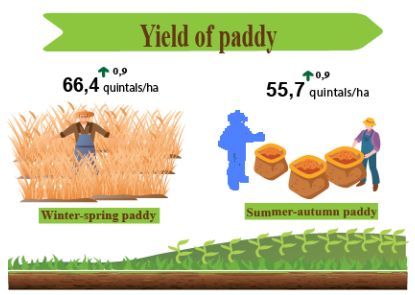
With the general trend of reducing the cultivated area due to land use purpose conversion, crop structure change; due to the effects of weather, it was estimated summer-autumn yield is still increasing compared to last year’s summer crop. Summer-autumn rice yield was estimated at 55.7 quintal/ha, up 0.9 quintal/ha, the highest compared to summer-autumn crops since 2015. The area of summer-autumn rice cultivation nationwide was estimated at 1,944.8 thousand hectares, a decrease of 64.8 thousand hectares, equaling 96.8% of the summer-autumn crop in 2019. As of September 15, 2020, localities had harvested 1,618.7 thousand hectares of summer-autumn paddy, accounting for 83.2% of the cultivated area and equaling 91.7% of the same period last year. The production was estimated at 10.83 million tons, down by 119.3 thousand tons, of which the Mekong River Delta harvested 1,272.1 thousand hectares, holding 83.5% of the cultivated area and an equal to 90.3% over the same period last year, productivity was estimated at 56.2 quintals/ha, increasing by 0.9 quintals/ha, equaling 101.7%; the output was estimated at 8.57 million tons, down 110.7 thousand tons.
As for the crop, the harvested areas of the Northern provinces are being 58.8 thousand hectares, accounting for 5.6% of the cultivated area and an equal to 60% over the same period. It is estimated that the productivity of winter paddy in 2020 of the Northern provinces will reach about 51.3 quintal/ha, an increase of 0.3 quintal/ha over the same period. The cultivated area of rice in this year’s winter paddy is low mainly due to the conversion to non-agricultural land for construction of irrigation works, infrastructure …; switch to other crops and aquaculture; or non-production due to some other reasons such as lack of labor, low production efficiency and a part of land interspersed between residential areas, industrial zones and craft villages so doing not plant.
The production progress of autumn-winter rice was lower than the same period due to the influence from the production progress of late summer-autumn crop; some areas do not have enough production time, so farmer temporarily let the land rest, in order to alluvium come to fields for the upcoming winter-spring crop. In addition, due to concerns about drought, high alum content in the soil, which can not guarantee production, some localities (Ben Tre, Tien Giang, Tra Vinh) have directed to cut down the area of autumn-winter paddy. In this year’s autumn-winter rice crop, the rice varieties favored by farmers for sowing such as: OM 5451, OM 4218, IR 50404, Jasmine 85, … Currently, the autumn-winter rice has been mainly in the stage of even flowering, catching and begining harvest.